
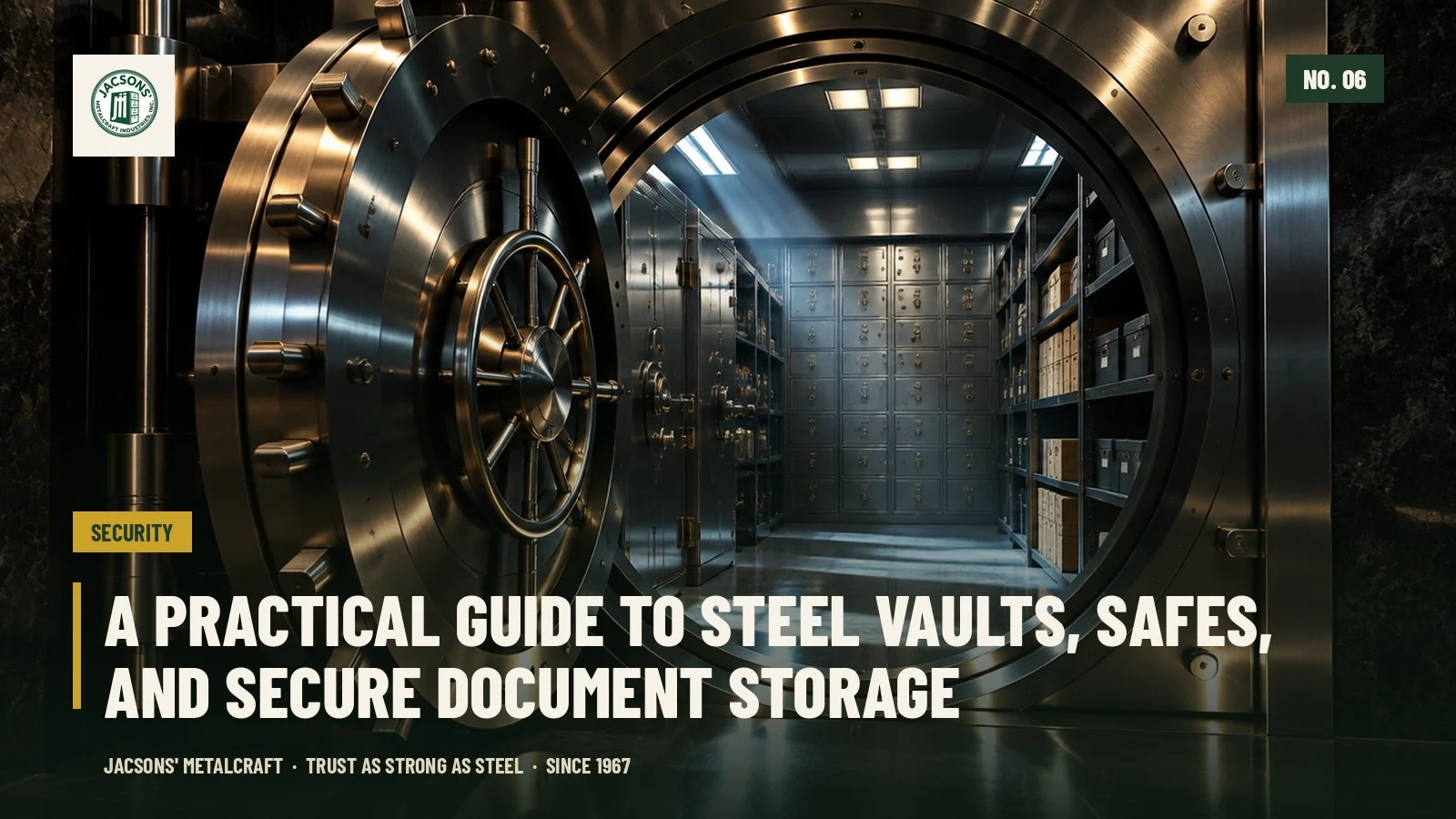
When a business outgrows a locked drawer, the options multiply quickly: safes, vaults, vault doors, cabinets with built-in safes. Each protects against different risks, and buying the wrong one means either overspending or — worse — discovering a gap after an incident. This guide explains the differences and how to choose.
Safes, vaults, and vault doors: what is the difference?
A safe is a self-contained secure box — portable in principle, though good ones are heavy and often bolted down. It protects cash, documents, and small valuables. A steel vault is a larger secure enclosure, effectively a walk-in or high-capacity safe for records, inventory, or bulk valuables.
A vault door converts an existing reinforced room into a vault — the approach banks and some offices take when they need room-scale security. There are also hybrids: a filing cabinet with a built-in safe covers offices that need everyday filing plus one genuinely secure compartment.
Choose according to what you are protecting
Start with the asset, not the product. Daily cash and a few contracts point to a safe or a cabinet-with-safe. Decades of irreplaceable records — land titles, archives, financial documents — point to a vault. High-value inventory or room-scale storage points to a vault door on a reinforced room.
Also consider access patterns. A safe opened twenty times a day needs a different form factor than an archive vault opened weekly.
Locking mechanisms and security requirements
Mechanical combination locks are proven, need no power, and last for decades. Key locks are simple but create a key-management problem. Whatever the mechanism, ask about relocking features, bolt work, and door thickness — and be honest with your supplier about your threat model. Protection against casual theft is a different specification than protection against determined burglary.
No product should be described as certified or rated without documentation. If a rating matters to your insurer or auditors, ask for the supporting papers before you buy — from us or anyone else.
Fire protection considerations
Fire is statistically a bigger threat to Philippine business records than burglary. Our safes are fire-proof insulated, designed to protect contents from heat exposure. When comparing options, ask what insulation is used and what level of protection it provides — and treat any specific fire rating claim, from any supplier, as something that should come with verified test documentation.
For truly irreplaceable records, combine approaches: a fire-insulated safe or vault, plus off-site or digital copies of the most critical documents.
Installation, access, and maintenance
Plan installation before purchase. Vaults and large safes are heavy — confirm floor loading, door widths, and stair or elevator access on the delivery path. Decide who holds combinations and keys, and document a succession plan so access survives staff changes.
Maintenance is modest: keep locking mechanisms clean, service combination locks periodically, and keep the unit dry. A locally manufactured unit has a real advantage here — service and parts are a phone call away rather than an import order.
Questions to ask before purchasing
- What exactly is this unit designed to protect against — theft, fire, or both?
- What are the door thickness, bolt work, and locking mechanism specifications?
- Is any fire or security rating claimed, and is documentation available?
- What are the unit's weight and dimensions, and will my floor and doorways take it?
- Can it be bolted down or anchored, and is installation included?
- Who can service the lock locally if it fails?
Frequently Asked Questions
Do I need a safe or a vault for business records?
For a manageable volume of current documents and cash, a safe or a filing cabinet with a built-in safe is enough. If you are protecting years of irreplaceable archives or high-value items, step up to a vault.
Are your safes fire-proof?
Yes — our safes are fire-proof insulated to protect contents from heat. For any specific fire-rating requirement (for example, from an insurer), ask us for the details and documentation so you can verify the protection level matches your need.
Can an existing room be converted into a vault?
Yes — that is exactly what a vault door does, provided the room's walls, floor, and ceiling are properly reinforced. We can assess your space and advise whether conversion or a self-contained vault makes more sense.
Ready to talk about your project?
Tell our Iloilo team what you need to store, your preferred dimensions and color, quantity, and delivery location.