
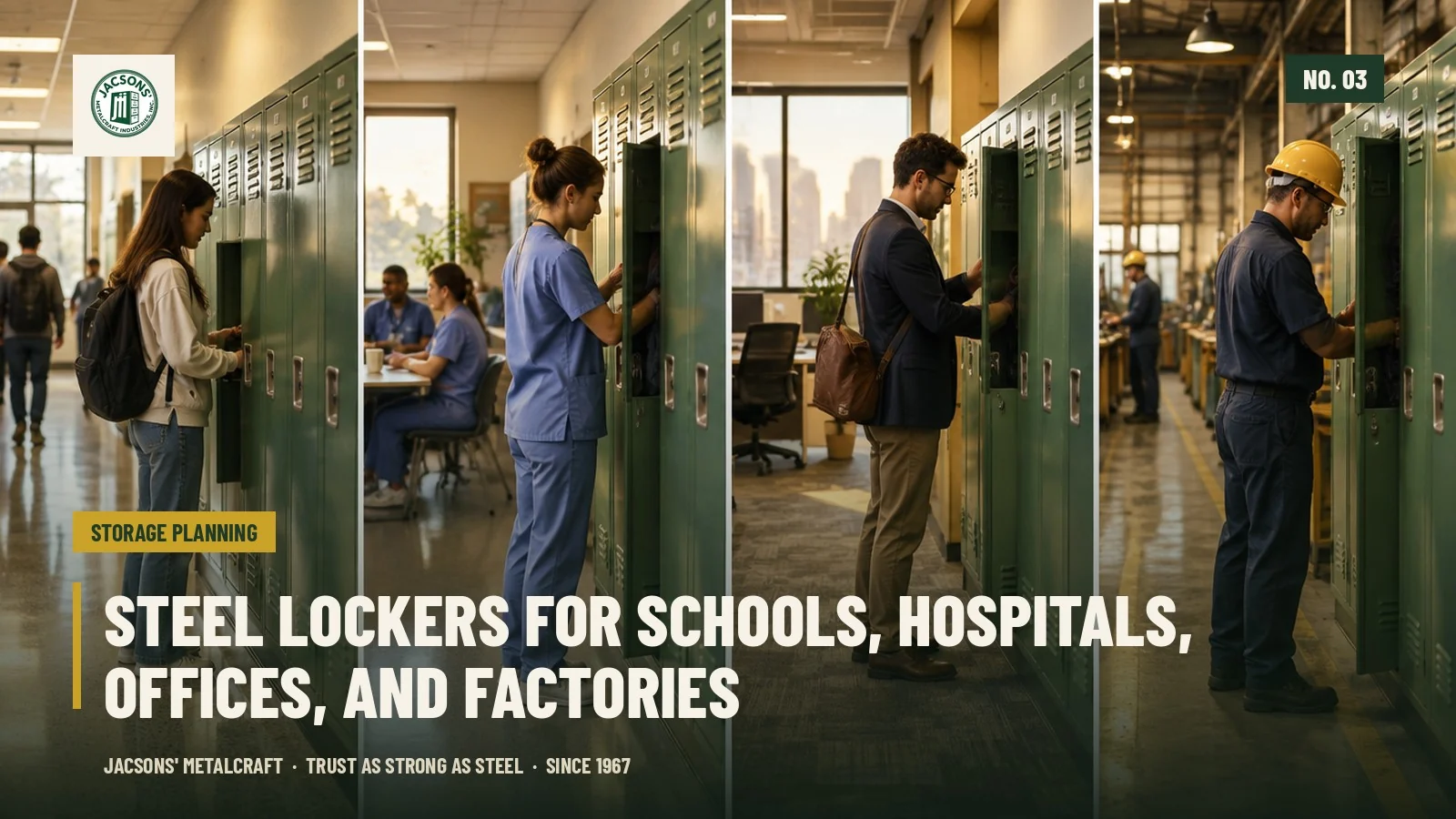
Lockers look interchangeable until a school has to manage eight hundred students' bags, a hospital needs ventilated storage for staff uniforms, or a factory floor requires lockers that survive daily abuse. The right configuration depends entirely on who uses it and how. This guide covers what facilities across the Philippines should consider before ordering.
Common locker applications
Schools and universities use lockers for student bags, books, and PE gear — high volume, rough daily use, and tight budgets per opening. Hospitals and clinics need staff lockers for uniforms and personal items, where ventilation and easy cleaning matter. Offices use smaller banks of lockers for employees' bags and valuables. Factories and warehouses need the toughest builds, often near changing areas.
Each setting points to a different configuration, which is why lockers are best bought by specification rather than off a shelf.
Choosing configurations and opening counts
Multi-opening locker units pack the most storage into the least floor space. Our range covers 9-opening, 12-opening, and 15-opening units. More openings per unit means smaller individual compartments — fine for bags, lunches, and valuables — while fewer, larger openings suit uniforms, helmets, or sports gear.
A practical approach: list what a typical user stores, measure the largest item, and choose the smallest compartment that fits it comfortably. Then multiply by headcount to get your unit count.
Ventilation, security, dimensions, and finish
Ventilation slots matter wherever lockers hold damp clothing, towels, or workwear — without them, odor and mildew build up fast in a tropical climate. For security, each opening should have its own hasp or lock point; decide early whether users bring their own padlocks (common in schools and gyms) or whether you issue keys (common in offices).
Check compartment dimensions against real items, not just the unit's overall size. And in humid or high-traffic environments, a quality spray-painted finish over properly prepared steel is what stands between your lockers and rust streaks within the first year.
Planning locker capacity for your facility
- Schools: one opening per student in the served grade levels, plus 5–10% spare for enrollment growth and damaged doors.
- Hospitals: one opening per staff member per shift that changes on site; separate counts for male and female changing areas.
- Offices: typically 60–100% of headcount depending on how many staff commute with bags or gym gear.
- Factories: one opening per worker per shift, sized for work boots and helmets where applicable.
Maintenance and procurement considerations
Steel lockers are nearly maintenance-free: tighten hinge screws annually, touch up scratched paint before rust starts, and keep floors under the units dry. Buying locally manufactured lockers means replacement doors, hinges, and locks remain available years later — a real advantage over imported units with no parts support.
For procurement, request a quotation with your opening count, compartment size, color, and delivery site. Public schools and government facilities should also confirm the supplier can support their procurement documentation requirements.
Frequently Asked Questions
How many locker openings does a school need per classroom?
Plan one opening per enrolled student plus a small surplus. A 40-student class is typically covered by three 15-opening units with a few compartments to spare.
Should locker users bring their own padlocks?
For schools, gyms, and factories, user-supplied padlocks are simplest — no key management and easy replacement. Offices often prefer issued keys so management retains access for inspections or emergencies.
Can lockers be placed in areas without air conditioning?
Yes — steel lockers with a proper painted finish handle non-airconditioned Philippine environments well. Choose ventilated doors for damp clothing, and keep the units off wet floors.
Ready to talk about your project?
Tell our Iloilo team what you need to store, your preferred dimensions and color, quantity, and delivery location.