
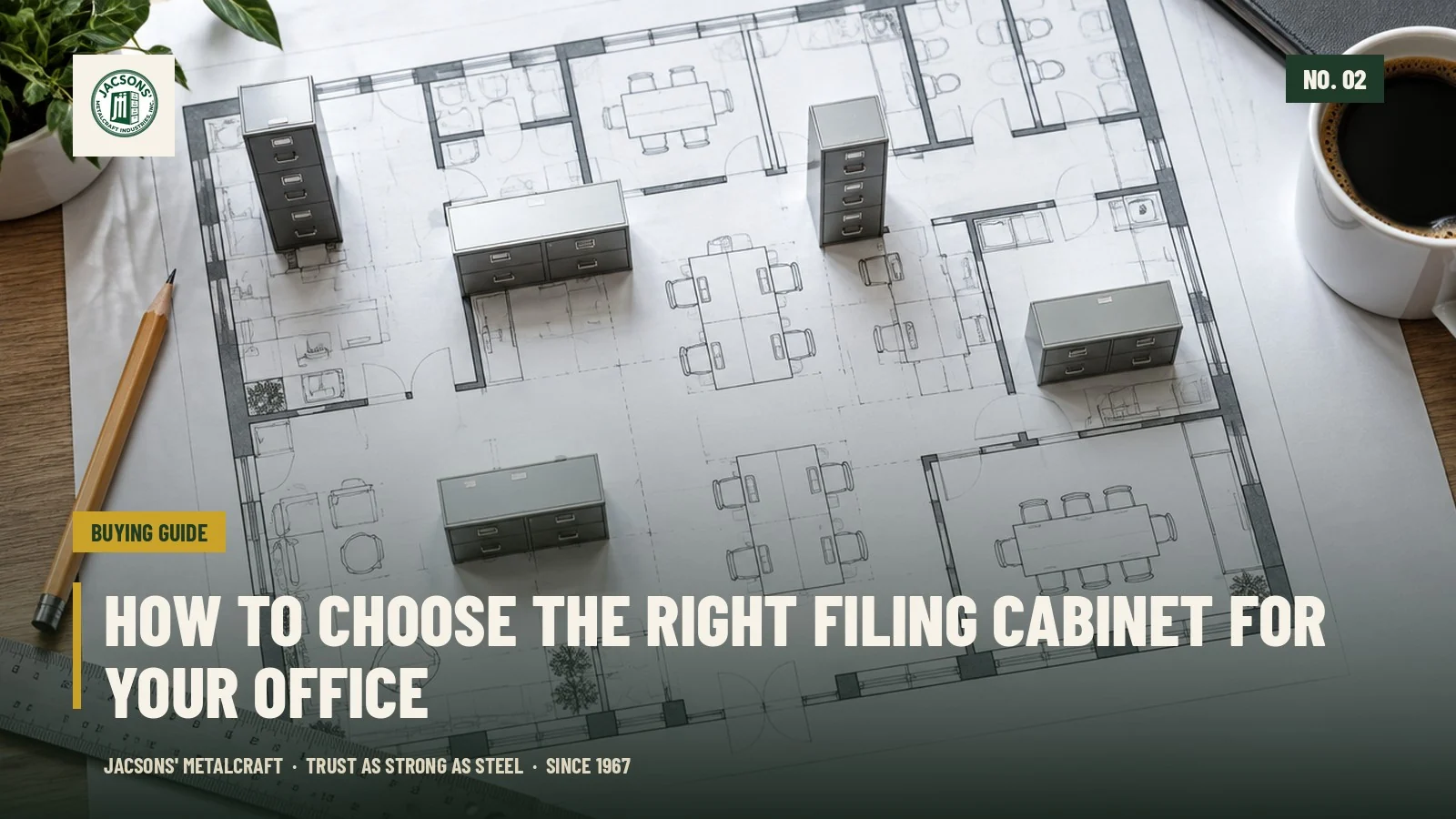
Buying a filing cabinet seems simple until you are standing in a records room wondering why the drawers will not open fully, why the aisle is too narrow, or why you ran out of space in eighteen months. The right cabinet is the one matched to your documents, your floor plan, and your growth. Here is how to work that out before you spend anything.
Start with your office size and storage capacity
Count what you actually need to store. Pull a sample of your active files and measure the linear width they occupy — a standard drawer holds roughly 60 to 70 cm of letter-size folders. Multiply by your annual growth and plan for at least five years.
Small businesses and clinics usually discover that one or two vertical cabinets cover their needs. Corporate offices, schools, and government units with permanent archives should plan in cabinets-per-department rather than buying piecemeal.
Vertical versus lateral filing systems
Vertical cabinets — like our 3-drawers steel filing cabinet — are deep and narrow. They fit beside desks and in tight corridors, and they are the most economical way to add capacity.
Lateral cabinets are wide and shallow. They double as counter space, allow side-by-side filing that is faster to scan visually, and suit dedicated records rooms. The trade-off is wall length: a lateral cabinet needs roughly a meter of clear wall per unit.
Document organization comes before furniture
Decide your filing logic first: alphabetical, by department, by year, or by case number. The system determines whether you need many small drawers (fine-grained categories) or fewer large ones (bulk storage). Offices that skip this step end up with cabinets that fight their workflow instead of supporting it.
Label holders on every drawer front — standard on our cabinets — sound trivial until you are managing a room of identical units. Insist on them.
Space planning and accessibility
Map the cabinet positions on your floor plan before ordering. Leave enough clearance for a fully extended drawer plus a person standing in front of it — about 1.2 meters of aisle is comfortable. Keep the most-used files between knee and shoulder height; rarely accessed archives can live in the bottom drawers.
If several staff retrieve files simultaneously, spread cabinets along a wall rather than clustering them, or choose lateral units so two people can work side by side.
Considerations by organization type
- Small businesses: one or two vertical 3- or 4-drawer cabinets near the work area; prioritize lockable drawers for contracts and cash records.
- Corporate offices: standardized 4-drawer verticals per department, plus lateral cabinets in the central records room.
- Professional firms (law, accounting, medical): lockable cabinets with fine-grained drawer organization; consider a cabinet with a built-in safe for sensitive files.
- Schools and government units: bulk 4-drawer verticals for permanent archives, planned for decade-long growth.
A practical buying checklist
- Measured floor space, drawer clearance, and delivery path (doors, stairs, elevators)
- Five-year storage estimate in linear centimeters of files
- Vertical or lateral decision based on room layout
- Steel gauge confirmed with the supplier
- Full-extension drawers with label holders
- Central keylock — and a plan for spare keys
- Finish suited to your environment (humidity, cleaning chemicals)
- Quotation covering quantity, color, delivery, and lead time
Frequently Asked Questions
Is a lateral or vertical filing cabinet better for a small office?
Vertical. It gives you the most storage per square meter of floor space and fits beside desks. Lateral cabinets make sense once you have a dedicated records area with long, clear walls.
How much space should I leave in front of a filing cabinet?
Plan for about 1.2 meters of clear aisle. That allows a fully extended drawer plus a person standing and sorting comfortably.
Should I buy one large cabinet or several smaller ones?
For growing archives, standardized 4-drawer cabinets added over time are easier to organize, relocate, and expand than a single oversized unit — and if one lock fails, you lose access to only a quarter of your files.
Ready to talk about your project?
Tell our Iloilo team what you need to store, your preferred dimensions and color, quantity, and delivery location.